
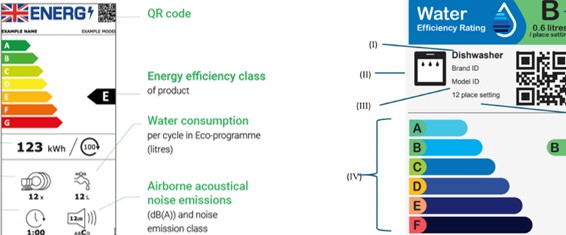
29 April 2026 – The Association of Manufacturers of Domestic Appliances (AMDEA) is today calling on the Government to urgently scrap a flawed new labelling scheme that will hit the UK appliance industry with an estimated £28 million+ upfront bill, a cost that will inevitably be passed on to households during the ongoing cost-of-living crisis.
The proposed UK Mandatory Water Efficiency Labelling Scheme (MWELS) will force manufacturers of “wet” appliances such as washing machines, washer-dryers and dishwashers, to display a new water efficiency label. However, water consumption is already clearly displayed on the existing, mandatory GB energy label.
AMDEA warns that introducing a second, visually similar label using completely different calculation methods, will not only cost businesses millions but will actively confuse shoppers and potentially add costs to everyday appliances.
New nationally representative consumer research commissioned by AMDEA also reveals widespread “label blindness” among UK shoppers, suggesting new labels will not improve understanding:
- Over half (51%) of consumers say there is already so much information on appliances that they find it hard to know what to focus on.
- Only a third (34%) usually read all the labels and information provided when buying a new appliance.
- Over two-thirds (67%) believe new labels should only be added if they replace an old one to keep things simple.
Stefan Hay, Chief Executive Officer of AMDEA, said: “This proposed regulation is the very definition of unnecessary red tape. The Government is forcing manufacturers to print millions of redundant labels and segregate stock for the GB market, creating a massive £28 million logistical nightmare. At a time when household budgets are stretched to the limit and manufacturers are trying to compete in a difficult trading environment, adding millions in regulatory costs that will inevitably trickle down to the consumer is completely unacceptable.
“Consumers are already overwhelmed by the amount of information thrown at them. Our research clearly shows they want simple, consolidated information, not a proliferation of contradictory stickers. The existing GB energy label has successfully driven massive improvements in water and energy efficiency for decades. Duplicating it with a flawed, conflicting metric will only undermine consumer trust and create confusion.”
A flawed ‘green’ metric that penalises smaller households
Beyond the £28 million initial burden and an estimated £5 million in ongoing annual costs, AMDEA analysis of several thousand dishwasher models shows the proposed MWELS metric is fundamentally flawed because it calculates efficiency based on “litres per place setting”. This means it favours large, full-size appliances and unfairly penalises slimline, compact or tabletop models often used by smaller households or those with limited kitchen space.
Chris George, Head of Trade Operations and Sustainability, Europe West at Electrolux Major Appliances and AMDEA Chair explained: “’The appliance industry, like so many other industries, is under pressure and this unnecessary new mandatory label will add further to our costs. Modern washing machines and dishwashers are extremely water efficient, and the existing energy label already tells consumers how much water is used per typical cycle. Adding another water label unrelated to the energy label information will create confusion for GB customers. We need the Government to remove ‘wet’ appliances from the proposed regulation urgently.”
EU conflict
Applying the MWELS label in Great Britain also creates a direct legal conflict with Northern Ireland. Retained EU law, which still applies in Northern Ireland, prohibits the use of additional labels that mimic the energy label to prevent consumer confusion.
AMDEA is urgently calling on Defra and the Minister for Water and Flooding, Emma Hardy MP, to review the scope of the MWELS Regulations and exclude washing machines, washer-dryers and dishwashers before the legislation is laid before Parliament in May.