
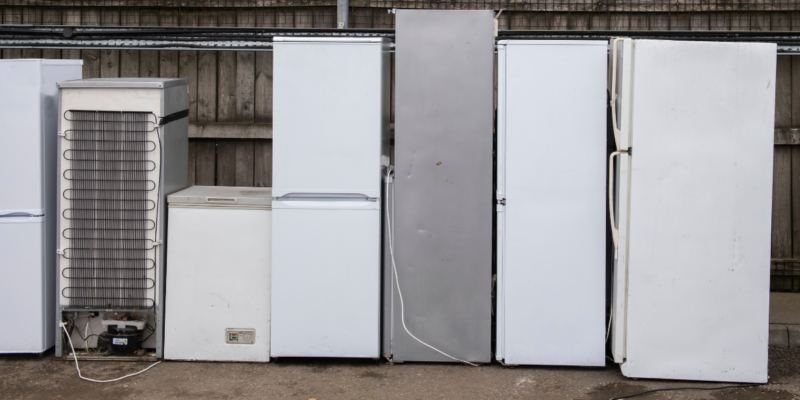
Appliance manufacturers call for coordinated action to tackle the UK’s fridge recycling backlog and investment in long-term treatment capacity
The UK’s fridge and freezer recycling backlog cannot be resolved simply by increasing costs for appliance manufacturers, according to the UK Home Appliance Association (AMDEA), which is calling for a coordinated national plan to restore specialist treatment capacity and strengthen the resilience of the entire recycling system.
The trade association, which represents the UK’s home appliance industry, says manufacturers remain committed to meeting their producer responsibility obligations and supporting safe, environmentally sound recycling. However, it warns that additional charges alone cannot overcome the infrastructure constraints at the heart of the current disruption.
With local authorities, producer compliance schemes and recycling operators facing significant operational pressures, AMDEA believes the priority must be to maintain collections, manage the backlog safely and establish a credible route towards additional treatment capacity.
Stefan Hay, CEO of AMDEA, said: “The fridge recycling backlog is a serious issue, and we recognise the pressure it is placing on councils, compliance schemes, recyclers and householders. Appliance manufacturers already finance their statutory responsibilities under the WEEE system and will continue to play their part. But we must distinguish between funding the recycling system and ensuring the physical infrastructure exists to process the appliances being collected.”
“A national shortage of specialist treatment capacity cannot be fixed simply by adding open-ended costs to manufacturers. Higher charges do not automatically deliver new treatment facilities, secure permits or create the contingency arrangements needed to prevent future disruption. While appliance manufacturers accept the need to finance the responsible management of products at the end of their useful lives, the current system does not consistently provide the commercial certainty, investment incentives or end-market demand needed to develop sustainable UK recycling and material recovery capacity.”
“What we need is a coherent, industry-wide plan that tackles the immediate backlog while encouraging investment in the additional capacity and resilience the UK needs. Government should work with producers, compliance schemes, recyclers and local authorities to reform the incentives, strengthen enforcement, support investment where genuine market failures exist and stimulate demand for recovered materials. The objective must be a system that delivers safe and effective recycling, secures the UK’s access to valuable secondary raw materials and provides a fair, transparent and economically sustainable allocation of costs.”
Under the Waste Electrical and Electronic Equipment (WEEE) Regulations, producers placing more than five tonnes of electrical and electronic equipment on the UK market must join a producer compliance scheme.
Through these schemes, manufacturers finance the collection, treatment, recovery and environmentally sound disposal of household electrical waste, including cooling appliances. Producer compliance schemes are responsible for arranging the necessary collections and treatment, including the clearance of cooling appliances from local authority sites, but producers cannot indefinitely absorb rising compliance costs without consequences for investment, competitiveness and consumers. Equally, recyclers cannot be expected to invest in specialist infrastructure without confidence that sufficient material will be available and that the costs of processing it can be recovered.
AMDEA stresses that producers are already integral to the recycling system, rather than standing outside it and that they support the creation of a market in which responsible recycling is properly funded, recovered materials have dependable outlets and efficient businesses have a credible reason to invest.
The association acknowledges that exceptional circumstances can generate legitimate additional expenditure, including temporary storage, handling, transport and potentially lawful export for treatment. However, it believes any additional costs must be transparent, proportionate, properly evidenced and directly connected to effective operational measures.
Stefan continued: “Producers are not seeking to avoid their responsibilities. We recognise that maintaining collections during the current shortage can involve genuine additional costs. These should be transparent, proportionate, properly evidenced and directly linked to effective operational measures.
“But there must be accountability for what those payments deliver. Simply transferring increasing costs to manufacturers without addressing the underlying capacity shortage is neither a sustainable solution nor an effective way to improve recycling outcomes.”
Government, regulators and the recycling industry are already pursuing measures to manage the immediate pressures, including temporary storage arrangements and work to support additional treatment capacity. AMDEA supports these initiatives where they are safe, properly controlled and evidence-based, but believes they must now form part of a coherent recovery and resilience plan.